Oxford players were out in force for the English Chess Championships in Kenilworth last weekend
In the open event of 84 players, Arya Cont, Alex Hertog, Jon Manley, Jan Murawski (all Oxford City) were joined by Magdalen College School’s fast-improving Noah Bevis and Oxford undergraduate Aron Saunders.
Oxford City’s Shambavi Hariharan competed in the women’s championship (10 players).
This was a tough 7-round affair featuring some of the best players in England, such as GMs Michael Adams, Gawain Maroroa Jones, Nikita Vitiugov, and WGM Elmira Mirzoeva. In such august company our fortunes were bound to be mixed but overall we did remarkably well.
Shambavi was the undisputed star of the Oxford show, sharing first prize in the English Women’s Championship with Elmira Mirzoeva on 4½/7, defeating the reigning champion in their individual encounter.
In some events that result would have been sufficient to crown her as the new titleholder, but the tournament’s rules prescribed a play-off of two rapid games. In an exciting finish followed by thousands of online chess fans, Elmira just edged it 1½–½.
A remarkable performance by Shambavi who at only 14 will have plenty of opportunities to repeat her success. A naturally gifted positional player, she has worked hard to hone her calculating skills, to devastating effect in the Oxford League last season.
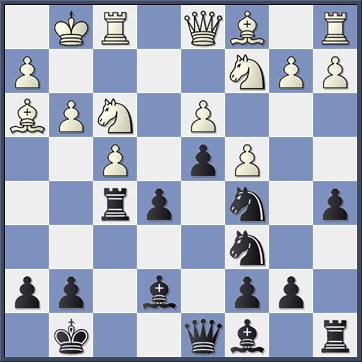
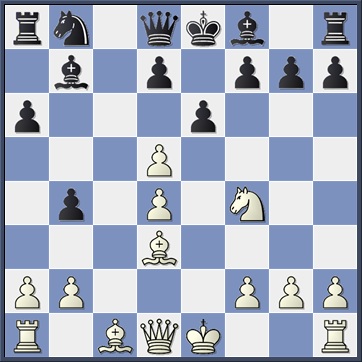
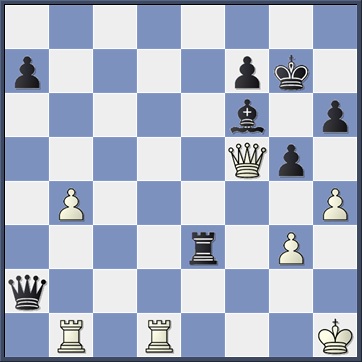
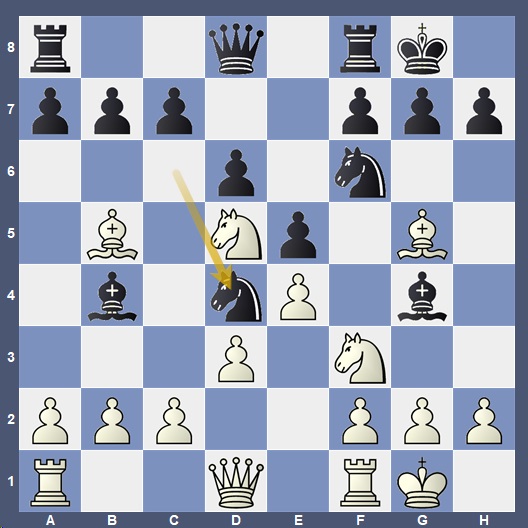
Elmira opened with the Réti system to reach this position which resembles a Benoni in reverse. She has just played 14.Bh3 to attack the rook.
14…exf4!
An instructive moment. Shambavi sees that for the price of the exchange she can dominate the white squares, consolidate her space advantage and target the weak d3-pawn.
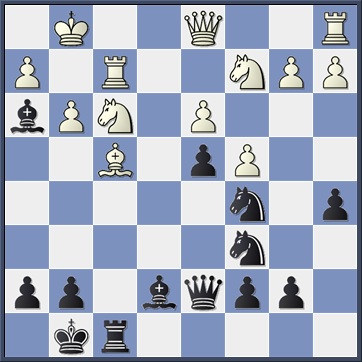
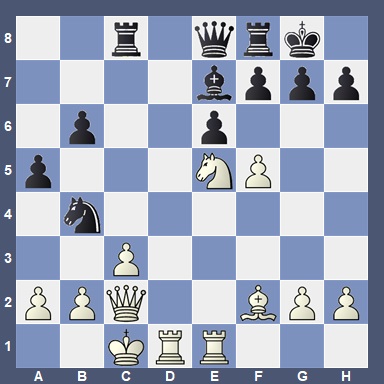
A very practical move to gain space on the kingside by driving the bishop back. The computer insists that g5 can be played immediately, but it’s a hard line to calculate and the resulting position tricky to assess: 19…g5 20.Bxg5 Bxg5 21.Nxg5 Rxf2 22.Kxf2 Qf5+ 23.Qf3 Qxg5 24.Qd5+ Ne6 25.Qxg5+ Nxg5 with advantage to Black.
20.Qe2 Bg4 21.Nce1 g5 22.Bd2 Bd6 23.Rb1?
White has to try 23.Bxa5 Nxa5 24.b4 Re8 25.Qc2 Re3 26.bxc5 Bxc5 27.Nd2.
Understandably, Elmira returns the exchange hoping to relieve some of the pressure, but her pieces remain bottled up on the back ranks. Shambavi’s domination of the board gives her a decisive advantage.
30…Qxf5 31.Qh5 Rf8 32.Qe2Ng4
33.b3
33.Rd2 was best but then Black breaks through with h4 and h3.
33…Nf234.Nc2 Nxd135.Qxd1? Qf2+
It’s mate next move.
0–1
An impressive display of positional control from start to finish.
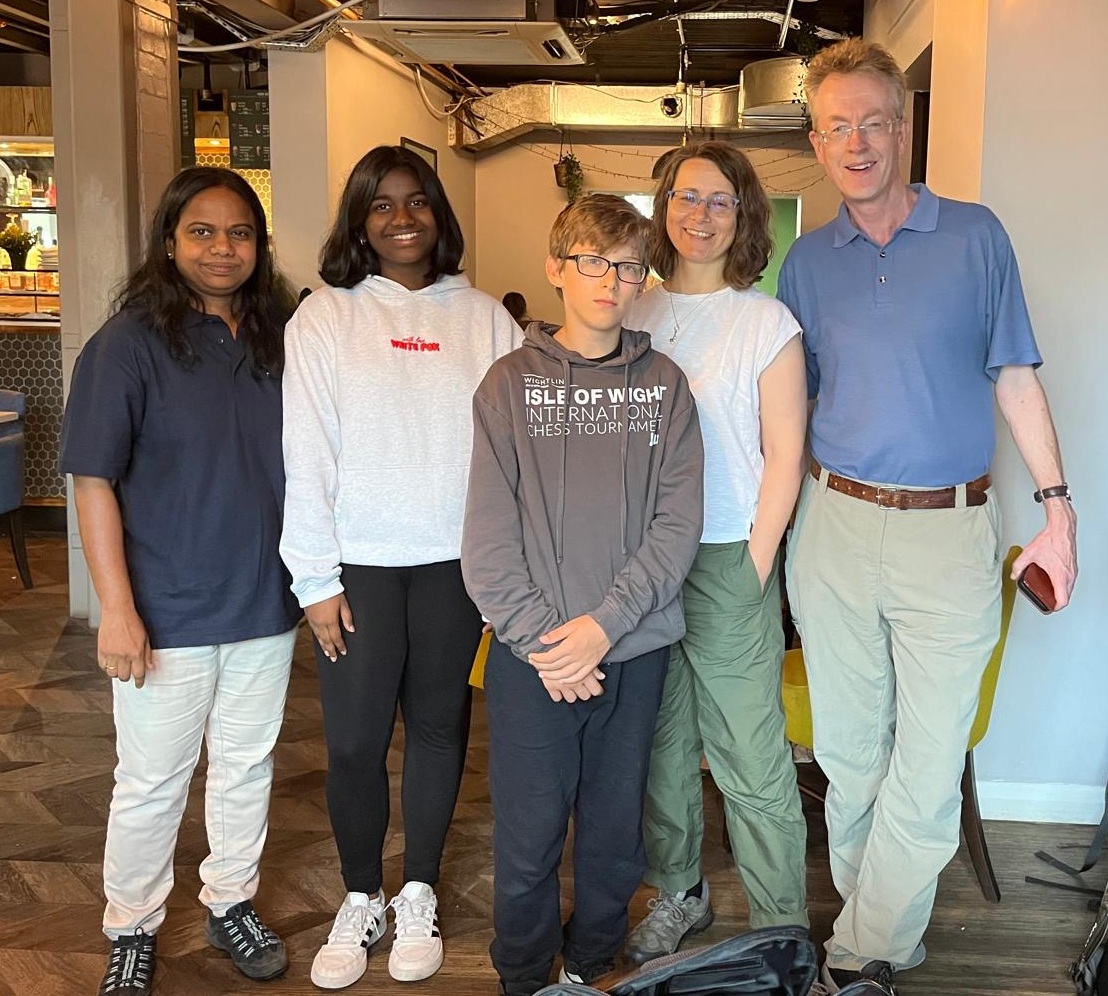
Before the play-off at Kenilworth (left to right): Shankari, Shambavi, Jan, Ola and Jon
Jan attacks
Jan Murawski did well to finish on 4/7 given that his opponents included GM Jones and IM Brandon Clarke.
He considers this his best game, against another promising youngster. Excellent opening preparation and enterprising attacking play bring home the full point, with a few bumps along the way.
Jan Murawski – Lion Lebedev English Open Championship 2025 (6)
So far so theory, according to Jan. He has just played Rb1 with a view to opening the b-file to Black’s king.
19…Qf6
A new move from Lion. Ne6, Ng6 and Qb6 have all been tried before.
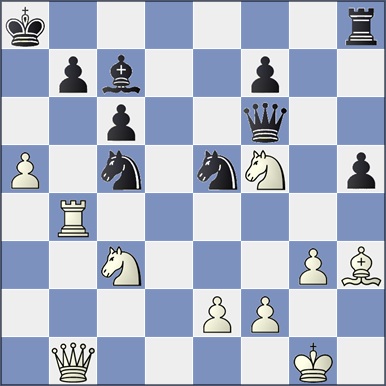
Giving Lion an opportunity to turn the tables. The best move is 33.Bf1 when Black has nothing better than 33…Rd6 34.dxc5 Re6 35.Rf4 Qe7 36.c6! winning for White.
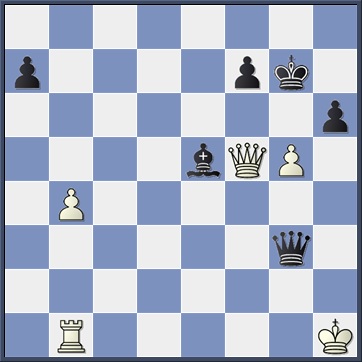
33…Ne5?
33…Rd1+ 34.Bf1 Ra1!! (the rook cannot be taken because 35…Qxf2+ mates) 35.Rxa6+ Qxa6 36.Qxf7+ Qb7 and Black wins.
34.Qa1 Rd2
Threatening mate in two by 35…Qxf2+.
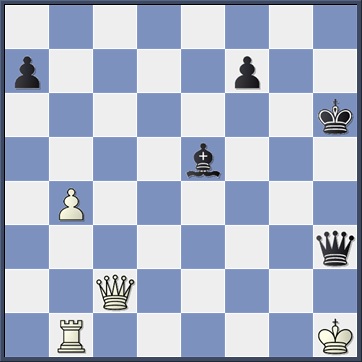
35.Rxa6+
A nice exchange sacrifice from Jan to expose Lion’s king and remove his own king from danger.
It was a pleasure to welcome back to the club Oxford University’s genial International Master Tom O’Gorman. Since his last visit two years ago Tom has clocked up several tournament successes, including an outstanding performance for Ireland in the last chess Olympiad.
On this occasion he took on 14 players, including most of our first team, and scored an impressive +12 =1 -1.
The most exciting game was against Oxford’s rising star Jan Murawski, who recently collected his Candidate Master title.
Tom O’Gorman – Jan Murawski
Oxford City simul, 03.02.2025
Polish Defence
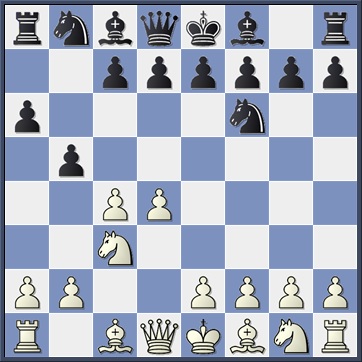
1.d4 Nf6 2.c4 a6 3.Nc3 b5
This interesting gambit seems to have been invented by the creative Georgian Grandmaster Bukhuty Gurgenidze in the 1970s. Lately Dutch GM Thomas Beerdsen has been its main champion.
Tom has come prepared as he has seen Jan trying out the line in internet blitz games.
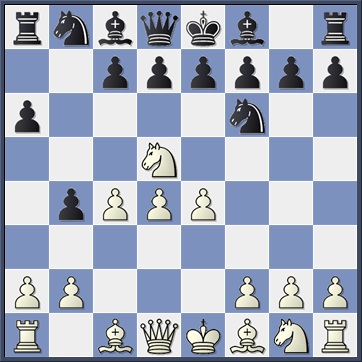
4.e4 b4 5.Nd5
5…Nxd5
An early master game went 5…Nxe4 6.Qf3 c6 7.Qxe4 cxd5 8.Qxd5 Nc6 9.Qe4 d5 10.cxd5 f5 11.Qe3 Qxd5 12.Nf3 g6 13.b3 Bg7 14.Bb2 Bb7 15.Bc4 Qe4 ½–½ Vaganian-Gurgenidze (Ordzhonikidze 1978).
Stockfish gives 15…Bxd5 16.h5 Nc6 17.Nxd5 exd5 18.Qe2+ Ne7 19.0–0 with advantage to White.
16.0–0 e5 17.h5!?
This enterprising piece sacrifice gives Tom a clear advantage. It is instructive that the computer prefers two alternatives aimed at opening up the e-file to Black’s king: 17.Ra4!? exf4 18.Re1+ Kf8 19.Rxd4 Qxd4 20.Bxf4 Kg8 21.Re8+ Kg7 22.Be5+ +–; or 17.Ba5 Qd6 18.Ne2.
After the game Jan felt that he should have castled here; Tom agreed but was confident that that he would have kept a strong initiative after 17…0–0 18.hxg6 fxg6 19.Nxg6 hxg6 20.Bxg6 Qf6 21.Bh6. The computer agrees too!
17…exf4?
The engine recommends 17…a5 18.Ne2 Qxb3 19.Bc3 Bxc3 20.Nxc3 0–0 when White is still a lot better owing to the weak dark squares around Black’s king.
18.Rfe1+ Kf8 19.Qxf4 Bxd520.Ba5!
A powerful move. The queen is overloaded and must abandon a key defensive square or diagonal if she moves: 20…Qf6 21.Qh6+ Qg7 21.Bb4+ Kg8 22.Re8+ Qf8 23.Rxf8#.
20…g5
Desperately hoping that exchanging queens and returning the piece will relieve some of the pressure. Tom shows no mercy.
Prepared to apply pressure: Tom gains the upper hand against Jan
Tom’s toughest test: Gabriel conjures up a mighty exchange sacrifice.
Tom O’Gorman – Gabriel Sherwood
Tom has nursed a small edge from the opening and can now collect a pawn by 26.Ra1 Qe6 (26…Qc4 27.Rd6 Be5 28.Rg6+! fxg6 29.Rxa7+ wins) 27.Qxe6 Rxe6 28.Rxa7.
But he is tempted to undermine Black’s weakened kingside instead.
26.h4?26…Rcxe3!
This timely exchange sacrifice completely turns the tables. It turns out that White’s king is even less secure than Black’s.
27.fxe3 Rxe3 28.Kh1
No better is 28.Qf2 Re2 29.Qf1 Qc4 30.Rb3 Bd4+ 31.Kh1 Qc6+ 32.Rf3 Rf2.
28…Rxg3?
This plausible move is not the best. Black can win by 28…Re2! 29.Qf1 (29.Qf3 Bd4!) 29…Qc2 30.Kg1 Qe4 31.Rb3 Bd4+.
29.Rg1 Qa3
30.Rxg3?
Missing a draw by 30.hxg5 hxg5 (30…Rh3+ 31.Kg2 Rg3+ 32.Kh2 Rxg5=) 31.Rxg3 Qxg3 32.Rf1=.
30…Qxg3 31.hxg5 Be5!
The point. The threat of mate on h2 gives White no time to organise counterplay on the f-file.
32.gxh6+ Kxh6 33.Qc2 Qh3+
0–1
34.Kg1 Bd4+ wins.
Fighting defence from Gabriel, well played!
Stuart White succumbedonlyafter stiff resistance
More valuable experience for Adam, his second game against a master
Duncan Reith was one of the last to finish, defeated by some masterly endgame technique
Many thanks to Tom for making this such an enjoyable and memorable evening. We are all looking forward to his next visit.
John Yates, who has died aged 92, was a longstanding and active member of Oxford City Chess Club. He made an enormous contribution to the club as a regular team player and captain, and was our affably effective treasurer for many years. He played for the county, was a regular at the Kidlington and Witney tournaments and was known to many players throughout Oxfordshire for his modesty, wry humour and skill at the board.
Born on 13 April 1932 in Egremont, Cumberland, John spent most of his childhood in Manchester, except when evacuated to a village in North Wales (close to an aluminium smelter targeted by the Luftwaffe!). After leaving Manchester Grammar school he tried his hand at carpet selling and farming, before obtaining a nursing qualification at Whittingham Hospital where he met his wife Jeannine. They married in 1955.
John then moved into accountancy, and in 1961 he and Jeannine settled in Oxford where he became treasurer of the Oxford Medical School. In the 1970s he had a spell as Accountant for the Randolph Hotel in Oxford before finally becoming a lecturer in Accounting at Oxford Polytechnic (which became Oxford Brookes University) until retirement. A keen cyclist, he would regularly ride his sit-up-and-beg bike to the Headington and Wheatley campus sites (dismounting to wheel it up Headley Way). He was an avid supporter of Oxford United since Southern League days, becoming a season ticket holder when the club moved to the Kassam Stadium. He would follow their results till the end when he couldn’t attend the matches.
He started playing chess for Kidlington Chess Club out of convenience because club nights coincided with the French adult education classes Jeannine taught in the same building – so they could drive there and back together. Jeannine remembers having to enter a smoke-filled room to find him after her lessons.
Mike March writes:
“John was one of the last of us old Kidlingtonians – chess players who, like me, belonged to Kidlington Chess Club before joining Oxford City when the two clubs merged. Now, sadly, John has passed on, following Ian Brooke, George Jones and Tony Wyatt before him, and leaving just Roger Smith and me as heirs to the Kidlington legacy. John was Kidlington Chess Club’s first team captain. We used to meet on Monday evenings and play our home matches at Exeter Hall, in rooms off the main hall. However, we did not have the building to ourselves and it could sometimes be acoustically challenging – to say nothing of what it did for you or your opponent’s concentration – whenever a roar would go up from spectators at a boxing match in the hall next door. But John, with his good-natured northern stoicism, always seemed the least fazed of any of us by such occurrences. Yet I believe he was a big Oxford United fan and a season ticket holder so maybe he saved his emotional energies for cheering on the U’s. One thing we know for sure, John was a great servant of and ambassador for chess, someone to whom, as chess players and club members, we shall always be grateful and who will long remain in our memory.”
John wrote some funny articles for our popular magazine Disinformator, edited by Sean Terry. ‘Yates’ Whine Lodge’ (Disinformator #29) featured the game Ben Savage v John Yates (University v City, Oxford League 1997). His note to the first move is priceless:
“ I. e4 d6
Sensation! When I married, I promised my wife, who is French, that I would always play the French Defence in her honour. This is only the second time I have been unfaithful!”
His waywardness is rewarded as he goes on to defeat the future FIDE Master in short order.
If John’s loyalty to the French Defence cost him points over the years, it brought some spectacular wins too. This article (from April 2003), written in the form of a letter to the editor, shows his resourceful play and self-deprecating humour.
Typically Effective Stodge
John Yates
“John Yates produced some typically effective stodge against Roger Smith, won a pawn, then the game…” Disinformator #26
Sir,
It is with some regret that I must ask permission to draw your readers’ attention to some of the rather hurtful epithets which you have attached to reports in your magazine of my recent games. They range from the condescending “habit of winning from lost positions” (#26) to the painful “lost for words” (#23) to the frankly derogatory “typically effective stodge” of your last magazine. (The last referred to a rather subtle win over a higher graded opponent!)
I realise that you and your associates are members of the crash bang wallop School of Chess, swashbucklers to a man, but you should spare some thought for the feelings and sensitivities of those of us who have led more sheltered lives, and enjoy a more thoughtful, considered, indeed subtle approach to what is, after all, the Beautiful Game.
I have therefore decided to speak out in my own defence. I admit some of the problem is my own fault, brought about by innate modesty, but I must force myself to put that aside – painful though that is – and present two games from my collection, both played against Simon Ansell (now an IM), just to show that I can swash a buckle just as well as the next.
The first shows an attacking combination of great panache, while the second contains the only move I have ever played over the board which I think deserves the word “brilliant”.
Simon Ansell – John Yates
Oxon Individual Ch, 6 January 1988
1.e4 e6
Yes I played the French Defence even in those days – it has been a great comfort to me over the years…
2.d4 d5 3.Nc3 dxe4
and this saves a lot of work, memorising, analysing!
All right – this is boring so far. [I didn’t say a thing! -Ed.] I have reached this position countless times and I don’t know what to do next, so I always produce the following manoeuvre – which never works.
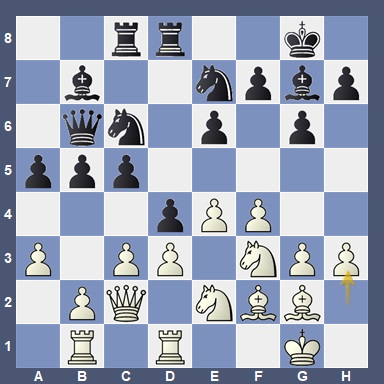
A typical Closed Sicilian position. Black’s queenside pawn charge is well under way, whereas White’s kingside pawn charge hasn’t even started. Incidentally, Black’s discovered check, which I always expect, never materialises.
14.Be3 d4 15.Bf2 Rac8 16.a3 a5 17.h3
Pathetic?
17…a4 18.b3 Qa7 19.bxa4 bxa4 20.c4
Hoping to block the position and start on the kingside, but this is doomed to failure. The black knights will intrude.
20…Rb8 21.Rb2 Na5
and here they come.
22.Rdb1
and perhaps here I should have snatched the a-pawn.
22…Bc6 23.Be1 Nb3 24.Nc1 Nxc1 25.Qxc1 Qc7
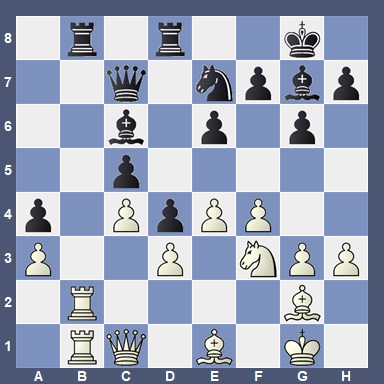
26.Ba5!!
Allow me two exclamation marks!! A bolt from the blue!! My opponent sat as though paralysed. I got up, hoping to draw the crowd’s attention to my move, but there was no one in the room. It was a quiet night in Cowley after the end of the season. In fact, no one has seen this move from that day until this, over twelve years later. I have been expecting Simon to produce a book “My Hundred Best Games” or some such, which would modestly include one or two losses. It has not appeared yet, and I cannot wait any longer, as I might drop down dead and the world would never see my masterpiece.
At this point the game was adjourned, for play-on, but Simon rang later to resign. This was the first game in a best of three in the semi-final, and he was eager to get on with it. He came out for the next two games like a tiger and I was torn to pieces. Still, as he was graded over 200 (2200) at the time, and later became an International Master, I was very happy with my win.
1–0
“Typically effective stodge” – indeed!
Yours, etc
John Yates
March 2003
With thanks to Eric and Jeannine Yates, Sean Terry and Mike March.
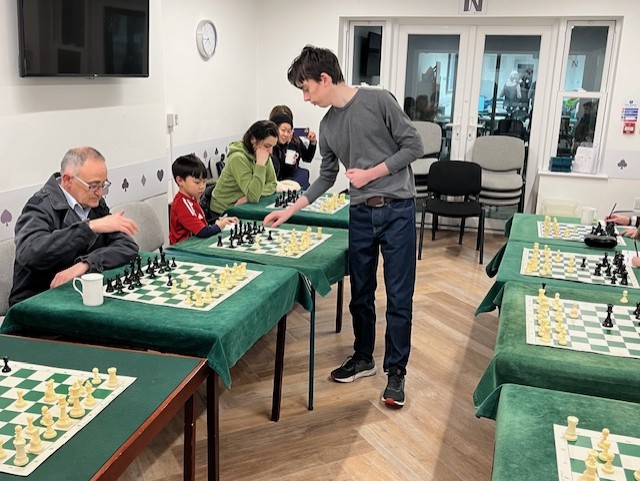
What better way to mark the start of the chess season than invite a strong master to give a simultaneous display?
Talented International Master Yichen Han has an Elo rating of 2429 and is still only 16 years old. Born in the Netherlands, he learned chess using the ‘Step Method’, improved rapidly and qualified for the IM title in 2022. Now a student at Oxford’s Magdalen College School, he is about to apply for a place at university to study mathematics and statistics.
“I’ll have no time to be bored!”
Yichen agreed to take on 17 of our members on Monday 14 October.
Most were facing a master over the board for the first time and played more in the hope than expectation of testing Yichen’s strength, but they were joined by a sprinkling of seasoned league players confident of snatching at least a half-point.
The addition of clocks (80 minutes + 10 seconds per move) upped the ante for the master. Yichen was relishing the challenge. “I prefer quick games and tend to get bored playing a classical time control. This way I’ll have no time to get bored!”.
In effect, Yichen would be playing 17 local league games at once against some of our strongest players, including junior stars Jan Murawski and Shambavi Hariharan. Jan had even beaten Yichen in a regular tournament game!
And how would Yichen fare against his 18th opponent, and arguably his strongest one: the clock?
Even our less experienced players were keen to put up a fight. There were no early baths even though the outcome of at least four or five games seemed decided out of the opening. That was by no means the end of the story though: Yichen’s 18th opponent could do some heavy lifting for any defender able to stave off checkmate for a while.
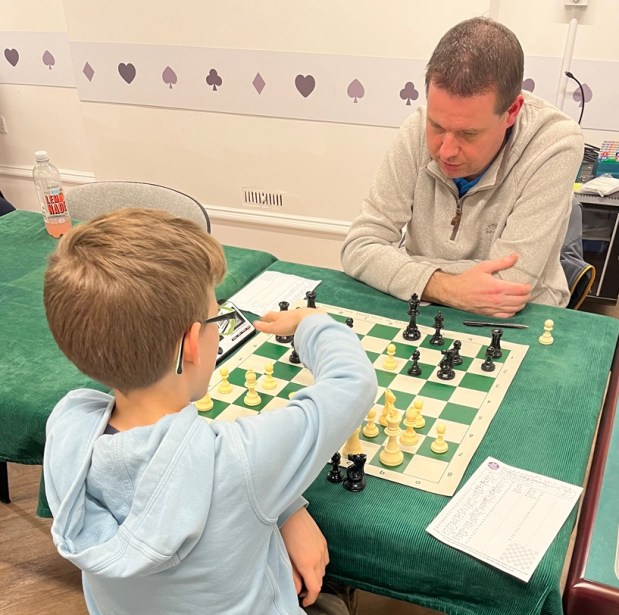
Stewart defends as Jan looks on
Club regulars Stuart White and David Gubinelli were holding their own; Cumnor’s Nigel Moyse seemed cruising comfortably to a draw; while Jan and Shambavi were starting to apply serious pressure and slowing Yichen down.
After an hour time began to tell. Yechu Zhang scored a surprise win on the clock, and Yichen rewarded David’s tough defence with a draw offer that was gratefully accepted.
Yichen took a draw from Jan who was beginning to build an advantage.
Shambavi offered the stiffest opposition and played a blinder, winning a pawn and frustrating Yichen’s attempts to muddy the waters. We’ll analyse her fine win in a future post.
Stuart also grabbed a pawn and made a well-timed draw offer in a position that was technically won for him.
Last man standing Nigel Moyse had a one-on-one blitz shootout with the master. He went astray in an even rook ending but Yichen sportingly made peace in a winning position.
Final score: 11½/17 (Won 9 Drawn 5 Lost 3)
Many thanks to Yichen for being such a good sport. It was an enjoyable and instructive evening we are all keen to repeat.
Junior champion Shambavi Hariharan on her way to beating the master
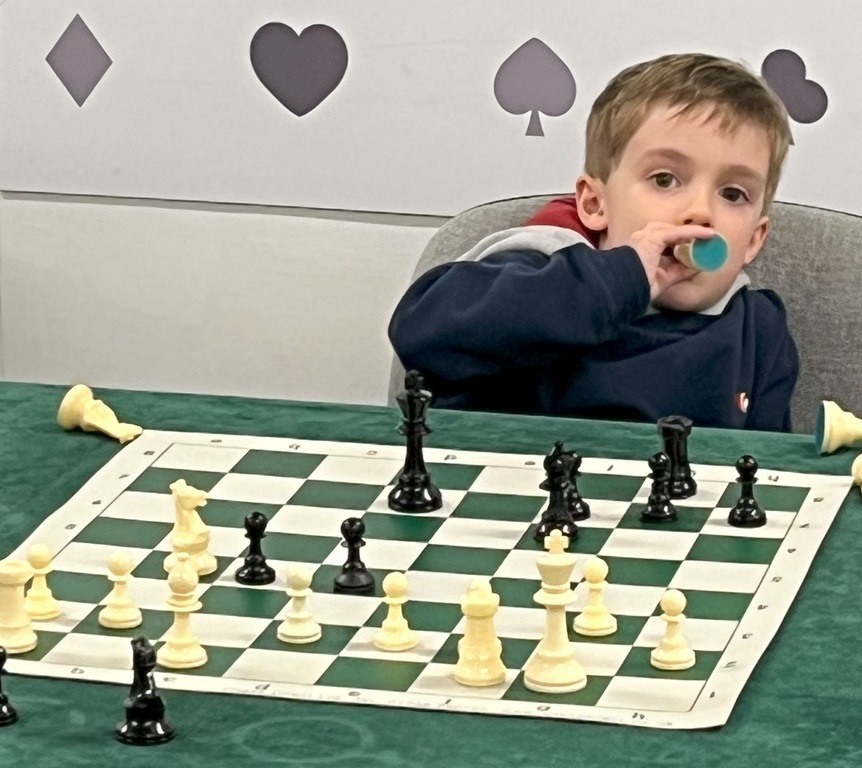
Young Xander Scott stayed the course well past his bedtime
Jan Murawski and Shambavi Hariharan played great games in our 6-0 defeat of Didcot 1 last week. Shambavi won a pawn in her favourite Caro-Kann and finished with a mating attack. Jan calmly cruised the complications of a dangerous gambit to expose his opponent’s king.
Jan Murawski – Nick Gough
Oxford City v Didcot 1, 20.03.2024
Albin Counter Gambit
1 d4 d5 2 c4 e5
Rarely seen in master chess these days, the gambit has a few strong grandmaster advocates including Alexander Morozevich.
This is Nick’s Idea – he’s lost a pawn but Jan will have trouble castling since it allows …Bxe2. Note that 11…Nxe5?? would lose to 12 Nxe5 Qxg2 13 Qd7 mate. The computer prefers 11…Rd8 12 Qc2 Nxe5 13 Bf4 Be6 14 Qxc6+ Nxc6 15 Bxc7 Rd7 16 Bf4 Be7 17 0–0 Bf6 with some compensation for the pawn.
12 b3 Bb5
13 e6!?
Jan is happy to return his extra pawn to saddle Black with a weak pawn on e6 and open the a1-h8 diagonal for his bishop. A good alternative was 13 Bb2 Be7 14 Qc2 0–0 15 Nd4.
13…f6?
After the game Nick admitted this was a mistake because it allows Jan to castle quickly. 13…fxe6 14 Bb2 Bd6 15 Bxg7 Rg8 16 Bb2 0–0–0 gives Black play for the pawn.
Jan makes an excellent practical decision to remove Black’s knight, seeing that his domination of the white squares will keep Nick on the defensive. Also strong was 27 f4 Ng6 28 Ba7 Rb4 29 Bf7 Qg4 30 Rfd1 Ne7.
27…Qxe5 28 Rc4 a5
28…Rxb3 29 Re4 Qxd5 30 Re8+ wins.
29 Re4 Qc3 30 Rh4 h6 31 Qh3
When each player controls squares of opposite colour, the one holding the initiative often has a decisive advantage, especially here where the heavy pieces add force to White’s attack. Jan threatens to win immediately with 32 Rxh6+.
31…Bf8
31…Qc2 is a more active way to secure the kingside. Black can only hope to relieve the pressure by exchanging pieces or sacrificing the exchange on b3, but he is never given the chance..
32 Bc4 Rd633 Qg4
33…Rbd8?
The ugly 33…g5 was the only way to hang on.
34 Rxh6+
With mate next move.
1–0
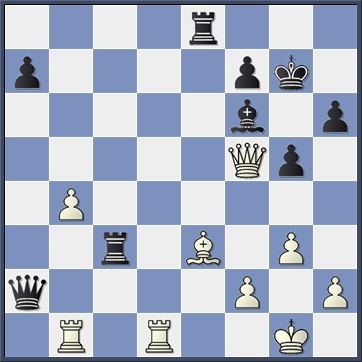
Shambavi carefully guided her passed a-pawn up the board and then unsettled her opponent by switching to full attack mode.
Reed – Hariharan
White’s king looks a little vulnerable whereas Black’s is sitting pretty behind his brick of pawns. Shambavi takes direct action.
36…Qb1! 37 Qe8+ Kh7 38 Qxa4
38…Rh1! 39 f4??
39.Qc4 seems to be best but Black is winning after 39…Qg1+ 40.Kf3 Rxh3+41,Ke2 Qg2 and Qf3+.
I blame Doctor Who. It’s my earliest memory of watching television.
To quote Wikipedia: “Doctor Who is a British science fiction television series broadcast by the BBC since 1963. The series, created by Sydney Newman, C. E. Webber and Donald Wilson, depicts the adventures of an extraterrestrial being called the Doctor, part of a humanoid species called Time Lords. The Doctor travels in the universe and in time using a time-travelling spaceship called the TARDIS, which externally appears as a British police box. While travelling, the Doctor works to save lives and liberate oppressed peoples by combating foes. The Doctor often travels with companions.”
Of the 15 actors who have portrayed the Doctor on TV, Patrick Troughton made the deepest impression. He was the second Doctor (after William Hartnell) and played him as an eccentric cosmic hobo who wore tartan trousers and blew a recorder. The late chess master Michael Basman would also have been convincing in the role.
What has Doctor Who to do with chess? One of the things that first drew me to the game was its time-travelling quality. It was a direct link to the past; to be sat pondering the very same chess position that had puzzled the Great Masters hundreds of years ago – wow! Chess was a kind of TARDIS. I could be a Time Lord too!
Apart from sparking an interest in the game’s history, this sense of wonder may explain why so much of my opening repertoire is still rooted in the early twentieth century.
All this crossed my mind as I was playing Will Burt last week. We reached this position after eight moves:
Jon Manley v Will Burt
Oxford City 1 v Cowley 1, Oxford League Division 1
The opening was the venerable Four Knights’ Game. It was all the rage in the 1900s; chess legends Lasker, Capablanca, Alekhine, Marshall and Tarrasch all reached this position.
White’s challenge is to break the symmetry and get a small advantage. What’s to stop Black simply copying White’s moves and making an early draw?
I remembered that this position is discussed in How to Play the Chess Openings by the fabulously named Eugene Znosko-Borovsky. This book was essential reading for chess players in the 1940s and Dad had given me his copy when I was a schoolboy. I could picture its green mildewed cover but couldn’t for the life of me recall any of its advice about the position. Damn!
This is what it has to say:
“The Four Knights’ Game is one of the quietest [openings]. White temporarily renounces the initiative and strives above all for the development of his pieces, Thus, move after move, the position is for a long time in equilibrium, and is sometimes even symmetrical.
But Black may fall into the mistake of believing that he can unthinkingly continue to repeat White’s moves. But as soon as White makes a slightly aggressive move, Black must abandon the symmetry or he will automatically suffer disaster.” (pp.46-7)
All well and good, but what’s White’s best try here?
He has four plausible ‘slightly aggressive’ moves – two captures, a capture with check and a fork:
9 Nxb4, 9 Bxf6, 9 Nxf6+ and 9 c3
After a while I chose the quiet 9 Bc4, challenging Will to be the first to deviate, but he declined with
9…Bc5
Time for White to be more aggressive.
10 c3
Now, following Znosko’s advice, Black must break the symmetry because 10…c6? would lose a piece to 11 Nxf6+ gxf6 12 cxd4.
10…Nxf3+ 11 gxf3 Bh3 12 Re1 c6 13 Nxf6+ gxf6
Now White can invite a return to symmetry with 14 Bh6, which was the choice of the famous attacking master Rudolf Spielmann. In that game his opponent gave up the exchange by 14…Kh8 15 Bxf8 Qxf8 with an eventual draw (Spielmann-Teichmann, San Sebastian 1912).
Will Burt is a dangerous player who will sacrifice the exchange in the blink of an eye. So rather than wave a red flag with 14 Bh6 I played
14 Bh4
The computer likes this move as it keeps an eye on Black’s main weakness, his f6 pawn.
14…d5 15 Bb3 d4?
A mistake because it loses time and exposes Black’s f7 pawn. His best plan is …Kh8 and …Rg8 immediately.
16 Kh1 Be6?? 17 Qd2
Suddenly Black is defenceless against White’s invasion on the g-file.
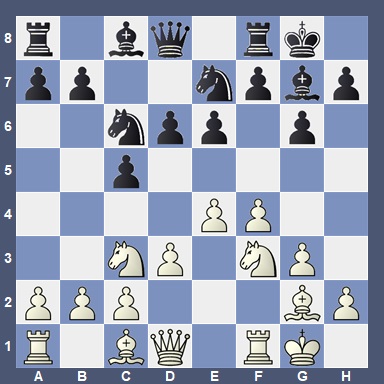
This still leaves the question: what’s White’s best move in this position?
All Znosko says in his book is that Black should avoid it altogether and deviate two moves earlier.
What about the Greats? Capablanca tried 9 Nxb4, and Alekhine 9 Kh1 (a bit tame for him). Meanwhile Tarrasch and Marshall were happy defending the black side against weaker opponents. Unable to take a spin in the TARDIS to seek their opinion. I asked Stockfish instead. Strangely the engine recommends 9 c3 and continuing the imitation game:























 Oxford City Chess Club