

John Yates, who has died aged 92, was a longstanding and active member of Oxford City Chess Club. He made an enormous contribution to the club as a regular team player and captain, and was our affably effective treasurer for many years. He played for the county, was a regular at the Kidlington and Witney tournaments and was known to many players throughout Oxfordshire for his modesty, wry humour and skill at the board.
Born on 13 April 1932 in Egremont, Cumberland, John spent most of his childhood in Manchester, except when evacuated to a village in North Wales (close to an aluminium smelter targeted by the Luftwaffe!). After leaving Manchester Grammar school he tried his hand at carpet selling and farming, before obtaining a nursing qualification at Whittingham Hospital where he met his wife Jeannine. They married in 1955.
John then moved into accountancy, and in 1961 he and Jeannine settled in Oxford where he became treasurer of the Oxford Medical School. In the 1970s he had a spell as Accountant for the Randolph Hotel in Oxford before finally becoming a lecturer in Accounting at Oxford Polytechnic (which became Oxford Brookes University) until retirement. A keen cyclist, he would regularly ride his sit-up-and-beg bike to the Headington and Wheatley campus sites (dismounting to wheel it up Headley Way). He was an avid supporter of Oxford United since Southern League days, becoming a season ticket holder when the club moved to the Kassam Stadium. He would follow their results till the end when he couldn’t attend the matches.
He started playing chess for Kidlington Chess Club out of convenience because club nights coincided with the French adult education classes Jeannine taught in the same building – so they could drive there and back together. Jeannine remembers having to enter a smoke-filled room to find him after her lessons.
Mike March writes:
“John was one of the last of us old Kidlingtonians – chess players who, like me, belonged to Kidlington Chess Club before joining Oxford City when the two clubs merged. Now, sadly, John has passed on, following Ian Brooke, George Jones and Tony Wyatt before him, and leaving just Roger Smith and me as heirs to the Kidlington legacy. John was Kidlington Chess Club’s first team captain. We used to meet on Monday evenings and play our home matches at Exeter Hall, in rooms off the main hall. However, we did not have the building to ourselves and it could sometimes be acoustically challenging – to say nothing of what it did for you or your opponent’s concentration – whenever a roar would go up from spectators at a boxing match in the hall next door. But John, with his good-natured northern stoicism, always seemed the least fazed of any of us by such occurrences. Yet I believe he was a big Oxford United fan and a season ticket holder so maybe he saved his emotional energies for cheering on the U’s. One thing we know for sure, John was a great servant of and ambassador for chess, someone to whom, as chess players and club members, we shall always be grateful and who will long remain in our memory.”
John wrote some funny articles for our popular magazine Disinformator, edited by Sean Terry. ‘Yates’ Whine Lodge’ (Disinformator #29) featured the game Ben Savage v John Yates (University v City, Oxford League 1997). His note to the first move is priceless:
“ I. e4 d6
Sensation! When I married, I promised my wife, who is French, that I would always play the French Defence in her honour. This is only the second time I have been unfaithful!”
His waywardness is rewarded as he goes on to defeat the future FIDE Master in short order.
If John’s loyalty to the French Defence cost him points over the years, it brought some spectacular wins too. This article (from April 2003), written in the form of a letter to the editor, shows his resourceful play and self-deprecating humour.
Typically Effective Stodge
John Yates
“John Yates produced some typically effective stodge against Roger Smith, won a pawn, then the game…” Disinformator #26
Sir,
It is with some regret that I must ask permission to draw your readers’ attention to some of the rather hurtful epithets which you have attached to reports in your magazine of my recent games. They range from the condescending “habit of winning from lost positions” (#26) to the painful “lost for words” (#23) to the frankly derogatory “typically effective stodge” of your last magazine. (The last referred to a rather subtle win over a higher graded opponent!)
I realise that you and your associates are members of the crash bang wallop School of Chess, swashbucklers to a man, but you should spare some thought for the feelings and sensitivities of those of us who have led more sheltered lives, and enjoy a more thoughtful, considered, indeed subtle approach to what is, after all, the Beautiful Game.
I have therefore decided to speak out in my own defence. I admit some of the problem is my own fault, brought about by innate modesty, but I must force myself to put that aside – painful though that is – and present two games from my collection, both played against Simon Ansell (now an IM), just to show that I can swash a buckle just as well as the next.
The first shows an attacking combination of great panache, while the second contains the only move I have ever played over the board which I think deserves the word “brilliant”.
Simon Ansell – John Yates
Oxon Individual Ch, 6 January 1988
1.e4 e6
Yes I played the French Defence even in those days – it has been a great comfort to me over the years…
2.d4 d5 3.Nc3 dxe4
and this saves a lot of work, memorising, analysing!
4.Nxe4 Nd7 5.Bd3 b6 6.Nf3 Bb7 7.c3 Ngf6 8.Qe2 Be7 9.Bf4 0–0 10.0–0–0
Cheeky – to play that (to borrow a phrase) against me!

10…Nxe4 11.Bxe4 Bxe4 12.Qxe4
Clearing the decks for…
12…Nf6 13.Qc2 Nd5 14.Bg3 a5 15.Ne5 Qe8 16.Rhe1 Rc8 17.f4 c5 18.dxc5 Rxc5 19.Bf2 Rc8 20.f5 Nb4!
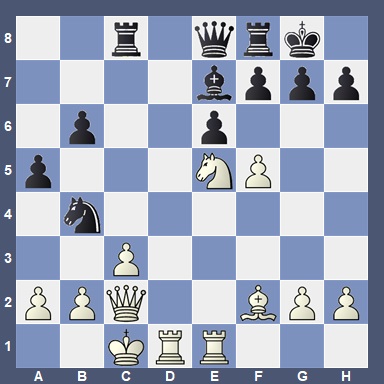
21.Qe4
The queen is needed here (or on e2), since if 21…Qb3 22.a4 embarrasses her off the board.
21…Qa4 22.a3 Na2+ 23.Kd2
And now the white king is forced back to the centre, as 23.Kb1 Nxc3+ 24.bxc3 Qb3+ is ruinous.
23…Bg5+ 24.Kd3 Rfd8+ 25.Bd4 exf5 26.Qe2
26.Qb7 Rxd4+! 27.Ke2 Qc2+ 28.Kf1 Rxd1 29.Qxc8+ Bd8! winning comfortably.

26…Rxd4+
and if 27.cxd4 Qb3 mate.
0–1
Typically effective stodge?! Well?
John Yates – Simon Ansell
Oxon Individual Ch, 4 June 1990
1.e4 c5 2.Nc3 Nc6 3.g3 g6 4.Bg2 Bg7 5.d3 d6 6.f4 e6 7.Nf3 Nge7 8.0–0 0–0
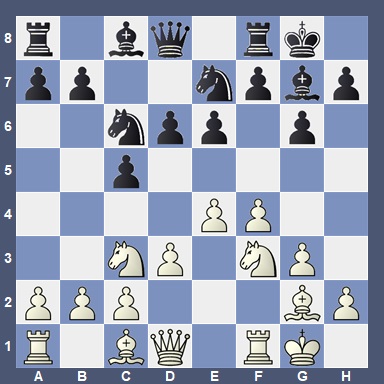
All right – this is boring so far. [I didn’t say a thing! -Ed.] I have reached this position countless times and I don’t know what to do next, so I always produce the following manoeuvre – which never works.
9.Ne2 b5 10.c3 Bb7 11.Rb1 d5 12.Qc2 Qb6 13.Rd1 Rfd8
A typical Closed Sicilian position. Black’s queenside pawn charge is well under way, whereas White’s kingside pawn charge hasn’t even started. Incidentally, Black’s discovered check, which I always expect, never materialises.
14.Be3 d4 15.Bf2 Rac8 16.a3 a5 17.h3
Pathetic?
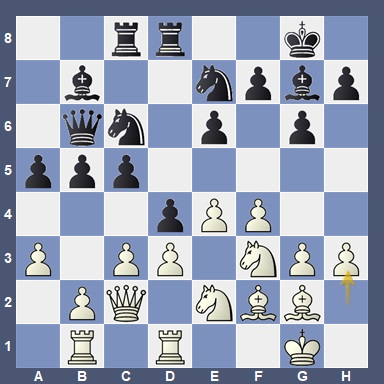
17…a4 18.b3 Qa7 19.bxa4 bxa4 20.c4
Hoping to block the position and start on the kingside, but this is doomed to failure. The black knights will intrude.
20…Rb8 21.Rb2 Na5
and here they come.
22.Rdb1
and perhaps here I should have snatched the a-pawn.
22…Bc6 23.Be1 Nb3 24.Nc1 Nxc1 25.Qxc1 Qc7
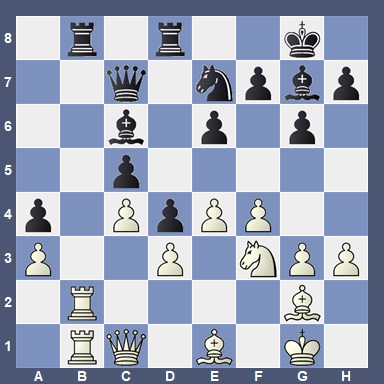
26.Ba5!!
Allow me two exclamation marks!! A bolt from the blue!! My opponent sat as though paralysed. I got up, hoping to draw the crowd’s attention to my move, but there was no one in the room. It was a quiet night in Cowley after the end of the season. In fact, no one has seen this move from that day until this, over twelve years later. I have been expecting Simon to produce a book “My Hundred Best Games” or some such, which would modestly include one or two losses. It has not appeared yet, and I cannot wait any longer, as I might drop down dead and the world would never see my masterpiece.
26…Qxa5 27.Rxb8 Nc8 28.e5 Bf8 29.Ne1 Qc7 30.Bxc6 Qxc6
At this point the game was adjourned, for play-on, but Simon rang later to resign. This was the first game in a best of three in the semi-final, and he was eager to get on with it. He came out for the next two games like a tiger and I was torn to pieces. Still, as he was graded over 200 (2200) at the time, and later became an International Master, I was very happy with my win.
1–0
“Typically effective stodge” – indeed!
Yours, etc
John Yates
March 2003
With thanks to Eric and Jeannine Yates, Sean Terry and Mike March.
 Oxford City Chess Club